Friday, May 11, 2012

Sintra National Palace: “For the best” (“por bem”)


To get the best view of the National Palace in Sintra you have to climb the ancient ruins of the Moorish Castle on the mountain nearby. Down below, in the middle of the old town, lies the palace.


The most striking feature are two enormous chimneys, that stick out over the roof of the palace. More or less the shape of the tower of the hop kilns (a building designed for drying hops as part of the brewing process) in Kent. The chimneys are (in) the roof of the kitchen. When you look up from the kitchen you can see the hole where the fumes go out. 

Originally the palace was built as residence for the Moorish governors of Lisbon. From 1147 onward it became the residence of the Portuguese kings until the monarchy ended in 1910. It is obvious that is was a place of splendid entertainment. While there, the Swans' room was full of people. It derives its name from the painted ceiling; covered with white swans wearing little golden crowns around their necks. 


In another room the ceiling is covered with magpies. The magpies hold ribbons in their beaks with the motto of the king: "Por bem" (For the best). It is the first known private "antechamber".


Everywhere in the palace (as everywhere in Portugal) are tiles. Different rooms have different tiles with different images, mosaics, forms. The vine pattern of the tiles (in King SebastiĆ£o's room) is unique.


The palace is a result of building efforts of many kings. The Arms room represents the centralised power of Manuel I. The ceiling in its heraldic glory. From this room the fleets going to or coming back from Brazil, Africa or India could be seen.


The most strange part tough are these two towering chimneys. The wind – straight from the Atlantic Ocean - blows over the openings and makes a howling noise in the kitchen. 


Alongside the palace are small but lovely gardens. When the cold ocean winds are gone, this friendly grinning lion would love to talk with you about all the kings and queens that kept him company before.... 


Tuesday, May 8, 2012

Tulips from the Gulbenkian Museum


When in Lisbon the Gulbenkian Museum is a must. Calouste Gulbenkian (1869 – 1955) was a British entrepreneur of Armenian origin. All his life he collected a wide range of art objects. Ceramics, ancient Egyptian art, paintings, furniture…. 


At first (part of) his collection was kept in his house in Paris. But when the Germans invaded France he fled to Vichy with the French Government. Later in 1942 he went on to Portugal. For a long time it was not sure where the collection would be housed. Some of it was in the British Museum,. Later on part went to National Gallery of Art in Washington.  

Finally 14 years after his death the unique fact happened that a museum was especially built to house a collection. The Calouste Gulbenkian Museum opened in 1969.


All sorts of art object to be seen in the museum. Here I would like to show some of the Iznik pottery from the 16th century that shows tulips. Under the patronage of the Ottoman court the Iznik pottery “flowered”. After the Persian city of Tabriz was captured by Sultan Selim I, he brought local artists from Tabriz over to Iznik to work in the ceramic industry.


During the 16th century colours were added to the initially Blue-White porcelain. First turquoise, later pastel shades of sage green and pale purple. In the middle of the century a typical red (bole red) replaced the purple and the sage green became emerald.


In Iznik of today they still produce tiles with the beautiful floral patterns.
Read more about the town of Iznik and Iznik tiles
Read more about the collection


Saturday, May 5, 2012

Queluz….. what a light…..


If ever there is a name for a palace that is more fitting than this one. “Que luz” is Portuguese for “what a light”. There is light coming in from the outside. There is light from chandeliers. And what light there is, is reflected by mirrors everywhere.


Queluz is rightly called the Versailles of Portugal. It is a Barok / Rococo palace built in the 18th century by prince Pedro and his Maria. A last dream palace before the French revolution changed the rules.


Passing through the ballroom…..
Into the throne room…..


As you walk there through these rooms you 
might even think you were back in the past. 
Two young people reflected into a door...


No it is not real. It is a mere reflection of the past. 
The kings and queens have left. 
The mirrors are worn by age. 
But what a light!


Wednesday, April 18, 2012

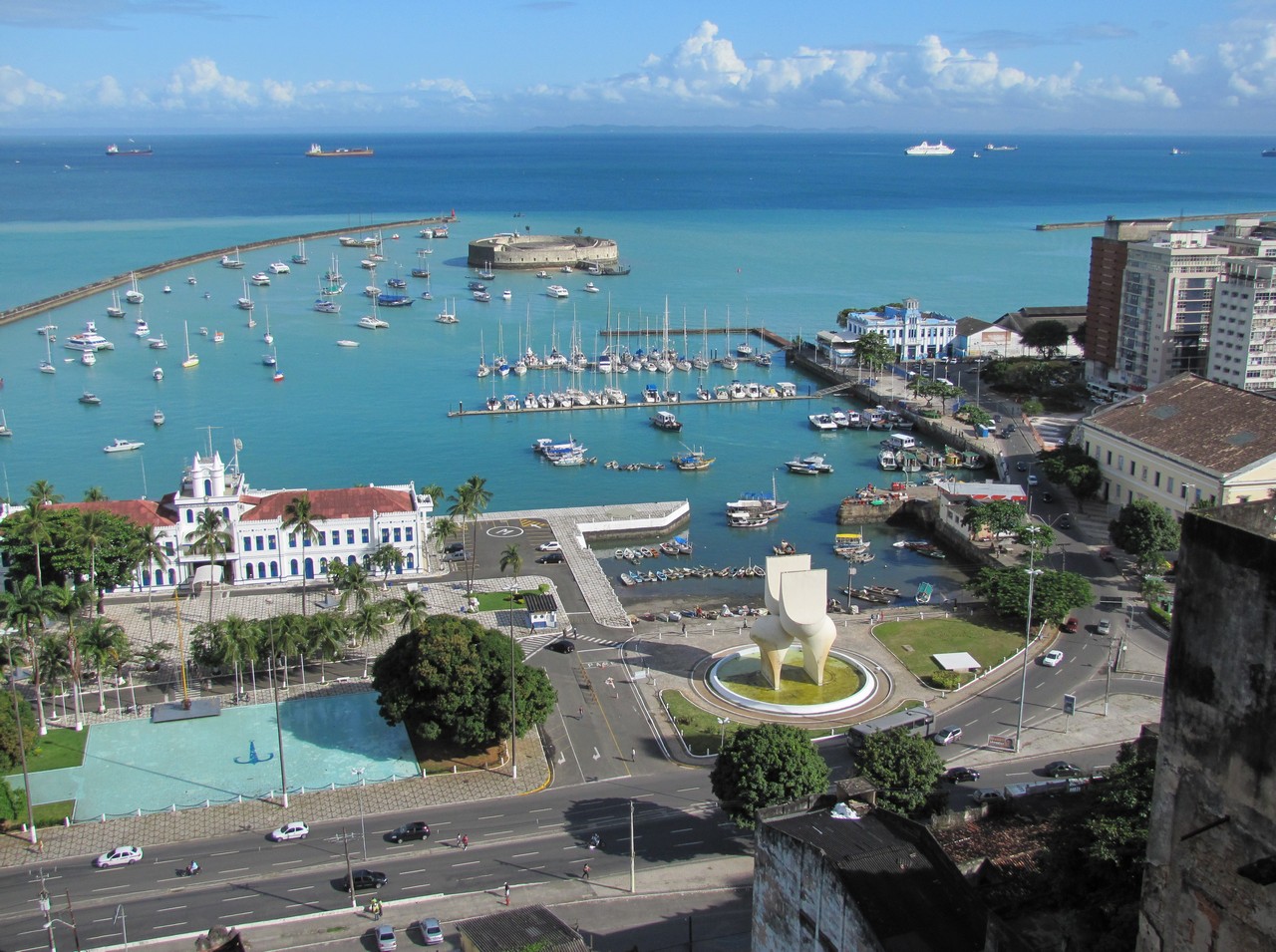
A little harbour in Salvador de Bahia…..


First we thought we were in the wrong place. Only a door in what looked like a dubious neighborhood. Just the stairs going up… It was alright though. On the first floor was a good hotel with a fantastic breakfast room. And then the surprise was complete. When we came onto the general balcony of our hotel… the view was stunning: Blue waters with an old fortress, a little harbour, a marina, stylish barracks for mariners, the old lower town, the statue - Monument for the city of Salvador (1970) - by Mario Cravo Neto. We could have spend our time there, but there were no parasols and the sun was uncompromising.


The “Elevador Lacerda” takes you down to the lower town. There is the Mercado Modelo; a large covered market. It has everything a tourist could want. From mini birimbau’s to hand bags and beautiful white linen. Outside are even more stalls. The restaurants are on the first floor. 


The balcony of the restauant offers a view of the small old harbour. The food is good, everybody is friendly, the toilets are terrible. But just sit there and look at what happens beneath you. It is the perfect place to spend the morning.


People, most young men, hang around there waiting for the odd job. The poverty is obvious.


The old man sitting on the stairs just washed himself, top till toe.


Next to the “Elevador Lacerda” is the former palace of the governor of Bahia. Another world. Extremes that will never meet.


Wednesday, April 4, 2012

Nice Trip to Boa Viagem….


Another sunny day in the north east of Brazil. The long beach of Recife is named Boa Viagem (Nice Trip). On a day like this the beach is full of people. 


Choose a chair and sit down. The man who owns the chairs will serve you all day with cold drinks. 

Looking from Olinda – Where Mauritius of Nassau resided in the 17th century – you see the coast of Boa Viagem in the distance.


All day “Vendedores” (sellers) walk along the water edge trying to sell their goods. All kinds of food and drinks, but also hats, suntan lotion, CD’s….  


Two “Repentistas” come to sing for us. Say a word and they will improvise for you.


At some places the beach dives steep into the sea…. The “vendedores” struggle to keep their carts out of the water.


The evening comes early. Even earlier because large apartment blocs cast their shadows over the beach. They are reflected in the retreating water on the beach. 

A large dead sea turtle is washed ashore. The men of the city cleaning take it away.


The sun bathers call it a day. The sellers get their things together to leave for their homes.
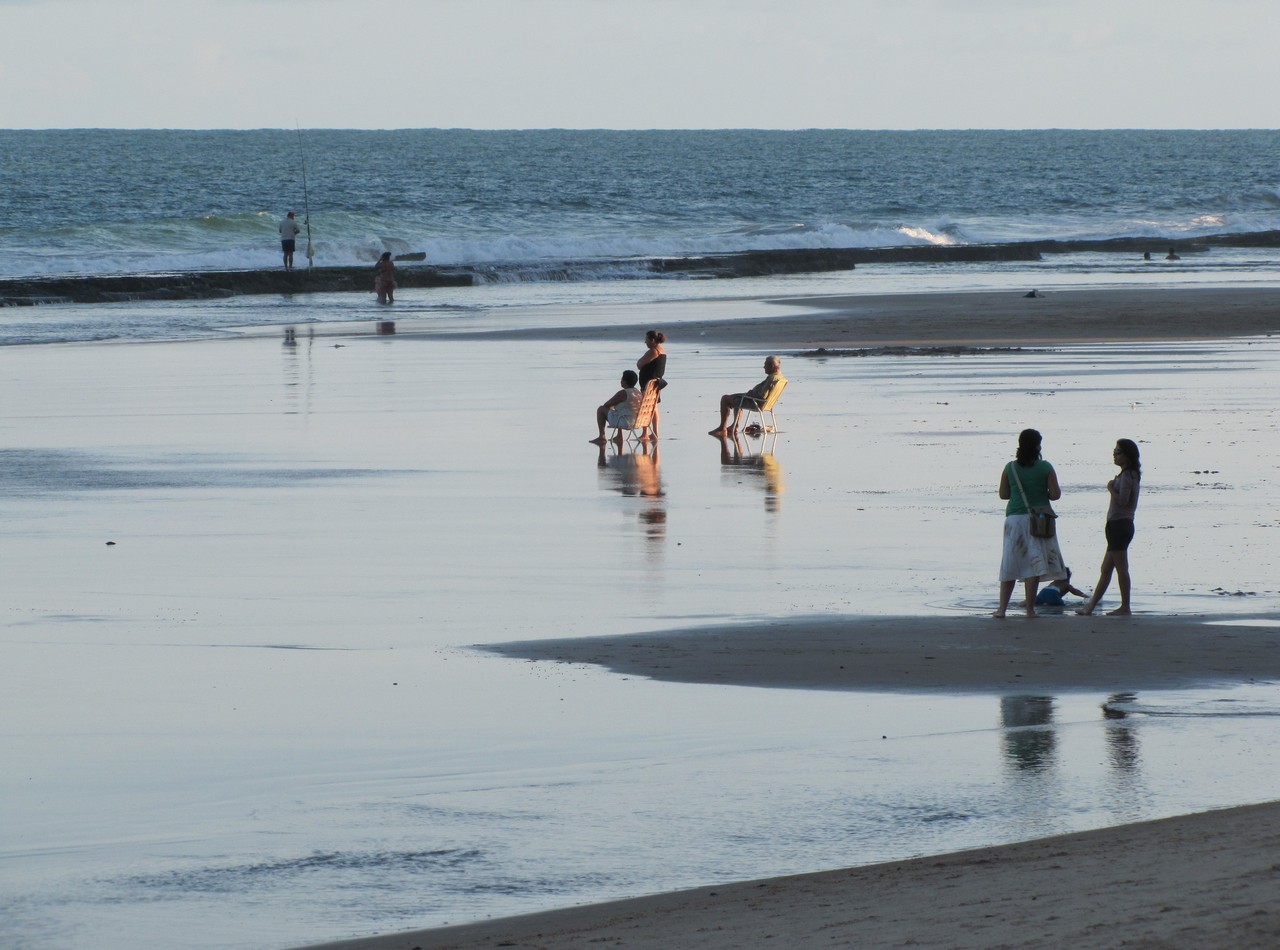
Some people stay to enjoy the fading light. Around 6 the sun sets and everything will be dark. 


See also: Brazilian beaches on Flickr