Wednesday, December 7, 2011

The MASP on the Avenida Paulista


To find the MASP you walk up the Avenida Paulista in São Paulo (Brazil). After some time - looking at the luxurious buildings with their reflecting fronts - you see a building on solid red legs. Standing in the water. It made me think of a huge reptile, without head or tail. A large open space under it's belly. Anything can happen there....  You have reached the Museo de Arte de São Paulo: The MASP.


It rains a lot in São Paulo….. So when we were there….. Go in the morning. The mornings are much better to see the outside of things. In the evening it will rain.  

The museum was founded in October 1947 by Pietro Maria Bardi together with the famous journalist Francisco de Assis Chateaubriand Bandeira de Melo, better known as Assis Chateaubriand or short; Chatô. In Europe. after the war, art was sold at relatively low prices because people needed money.

My friend Fernando Morais (the biographer of Paulo Coelho: A Warrior's life) wrote a book about this Chatô - http://www.fernandomorais.com.br/ (Excuses for the fact that some of the text's are only in Portuguese.- Please Brazilians add to the Wikipedia in English!) 

The interesting building that houses the MASP was designed by the wife of Pietro Maria Bardi, the architect Lina Bo Bardi. 


Up you go with the elevator to the entrance. How surprising this space with murals and red stairs. You are allowed to take pictures there. 


It is a sort of landscape with red components, totally different from the grey outside. Like a sculpture in red with some black accents and colorful murals. 


Even the space for children is part of this landscape. 


The 3rd floor where the exhibitions are held is different; more classic. No pictures there… It’s a pity because the collection is excellent. 

While we were there, there were three exhibitions: The most important – at least to my taste – was the exhibition of portraits I thought the exhibited collection was marvellous; varied and entertaining. There were works of: Renoir, Van Gogh, Modigliani, Rivera, Picasso, Toulouse-Lautrec, Frans Hals, Goya and Rembrandt.

There was another exhibition “Deus e Madonnas” Gods and Madonnas. A real good subject for Brazil. With works of masters of the 14th till the 19th century.

Finally there was the “Romatism: The art of enthousiasm”. With works of Bosch, El Greco, Monet, Renoir, Van Gogh, Dalí, León Ferrari, Tomie Ohtake others


Brazilians in the last century looked very much to Europe for “Art”. This museum is mainly about the European art. Accept this and you will enjoy very much being at the MASP. 

More relevant links:
The Masp and Baldi
The building 1
The building 2
TV-Coop about MASP

Thursday, November 24, 2011

The road to Ubatuba


The first time I heard the name Ubatuba it sounded very exotic to me. Where could that be? I was told that we could go the beach there.

Only in the north-east of Brazil wide rivers go to sea. In the rest of the country rivers flow into the country and most of them end up in the Rio de la Plata in Argentina. The Portuguese that landed at Rio the Janeiro thought they found a river (in January)…. But alas no river just a large bay. It is because right behind the coast lies a mountain range: The Serra do Mar. 


The clouds from the ocean bump into the mountains and provide the water to sustain the rain forest (the Mata Atlântica) on the coast. 


So when you want to go to the sea you have to cross the serra. From Taubaté it is 90 kilometers by bus across the Serra do Mar. 

The landscape on the land side of the serra reminds me of England; nice flowing green hills. Only the vegetation is different. Plumes of bamboo, palm trees, banana plants and too many Eucalyptus trees. There are cows and horses grazing. Some meadows are full with anthills. The earth is bright red. Erosion is everywhere.

After three quarters of the trip you reach a pass on around 1000 meters. Once you passed that pass the road goes down. I tried to count the very steep curves. There are at least 25 of them. The bus slows down to first gear and needs the left lane to round the curves. 


Here in Brazil they even sing a song about a bus driver Barbosa going over the serra: O Barbosa, essa curva é  perigosa.


At the end of the curves the first house you see has an “SOS breaks service” sign….  and sells bananas. 


Finally we arrive in Ubatuba. Ubatuba is an Indian name and it means “many canoes”. Ubatuba has some fine old Portuguese houses. 


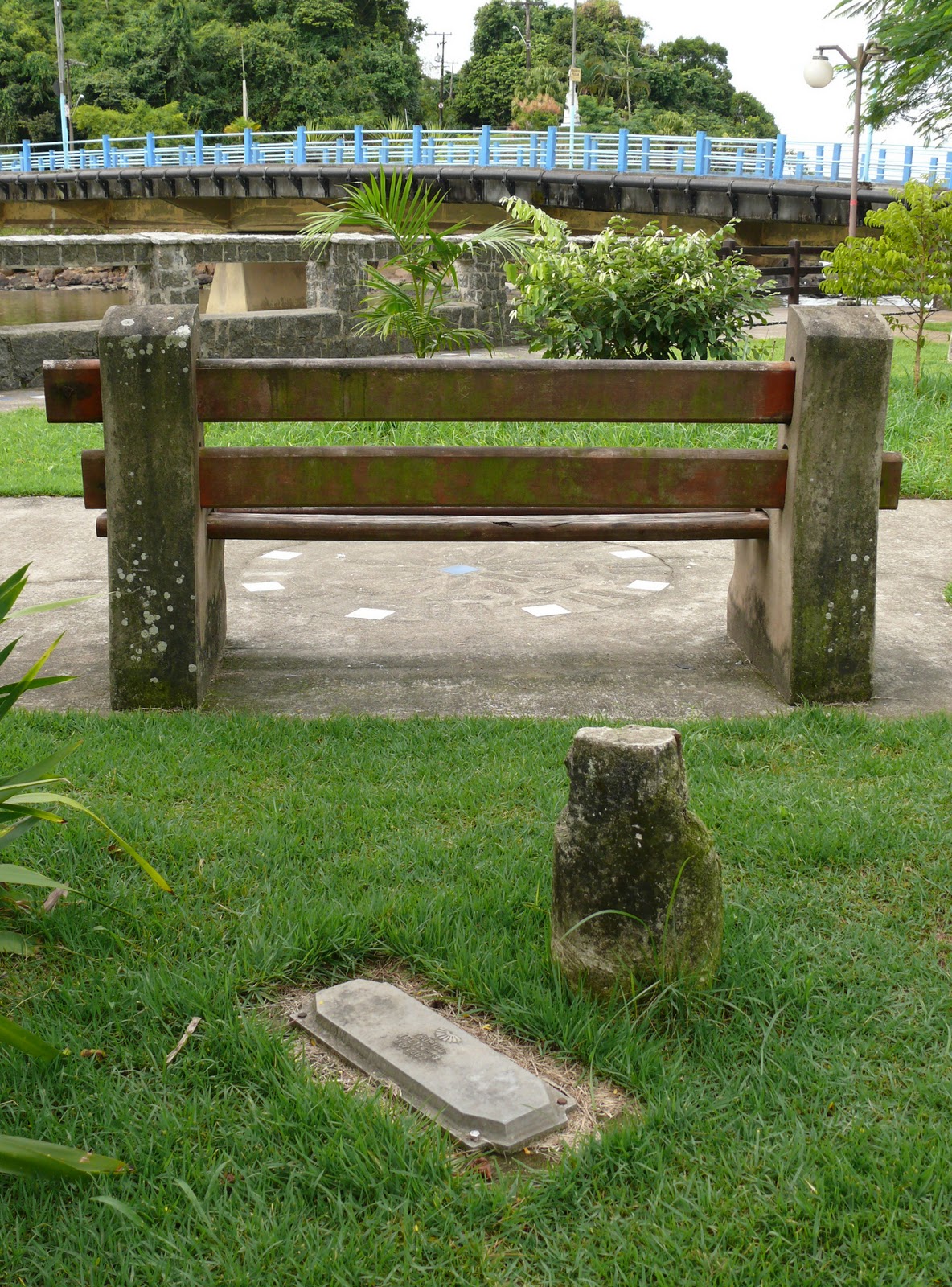
But there is something far more interesting here. The Tropic of Capricorn reaches the continent of Latin America in Ubatuba. You have to search for the small sign in the grass behind a seat. But there it is!


 Next time we will go to some of the 84 beautiful beaches of Ubatuba!


Monday, November 14, 2011

Brazilian children love Emilia


Monteiro Lobato and family


The most famous writer of Taubaté is without doubt Monteiro Lobato. He created Emilia, a dominating, obstinate rag doll that has adventures with two children Pedrinho and Narizinho. But there is also, the grandmother Dona Benta that tells the stories and the maid Tia Nastacia. Tia Nastacia made Emilia and also the half man half corn person Visconte de Sabugosa. Emilia comes to life by eating a speaking pill. Sometimes the Saci, a one legged creature from Indian legends, appears in the stories.

Emilia and Tia Nastácia
The Saci

Most of his stories start with the grandmother telling a tale to the children. Then the children and the doll become involved in the story and go off into their fantasies.

Grandmother telling....

During the dictatorship some of his books were prohibited because in some stories the children used a magic powder. This made conservative and clerical powers think Monteiro Lobato was writing about the use of cocaine. 

The sitio Pica-Pau (Woopecker farm) where Monteiro Lobato was born and where he lived has become the centre of Monteiro Lobato  activities in Taubaté / Brazil. Many, many children go there. Either with their school or with their parents. The house is made into a museum, there is also a library and there is a little shop where you can buy “Emilia’s”.


Library
Saci
Emilia rag doll


The day I went there was bright and sunny. Walking under the old trees was refreshing. You couldn’t imagine that just outside this oasis was the busy traffic of Taubaté. In the park you meet the figures from the books. The statues are made of concrete and painted in bright colors. There is also a small band stand in the grounds.


Several times a day there is a show for children in a part of the old farm. The actors perform one of the stories. We saw part of a show. No photos because of copy rights!! The children were completely absorbed by the spectacle. This time they went to the moon!


In the grounds we saw this huge tree, the Jaca tree, with extremely big fruits. The vicinity of the tree was closed off, because you can imagine what happens when a fruit like that falls on your head.


Monteiro Lobato sure made Taubaté the Brazilian capital of children's literature


Wednesday, November 2, 2011

A Church and a chapel


In the Serra do Mar, between Ubatuba and Taubaté lies the town of Redenção da Serra.


Going to Redenção coming from Taubaté the first thing you see is a derelict church with a wall around it and some houses on the edge of a muddy end of a lake. This is the old church. Redenção used to be a nice little place in a valley.


It was the first town in the state of São Paulo to free its slaves; on the 10th of February 1888, even before the “Lei Aurea” came into power on May 13 1888. Also because of this fact in the first half of the last century the name of the town was changed from Santa Cruz de Paiolinho to Redenção da Serra. Driving into town right across the bridge there is a large statue to commemorate the abolition. The statue was made by José Demetrio, a well known local sculptor in the Paraiba valley.


In the 70-ties the demand for electrical energy was growing. The solution to the problem was to build a dam in the Paraibuna river. Then the dam came…. And the old town of Redenção was flooded. The church on the high ground still stands but is slowly falling apart. Now it is protected by a wall against the water. When we were there the water level was low. But the water can rise until almost the top of the wall.


For the inhabitants there was no option to stay. They either could go away and start a life in another city or they could move to a new town on the hill a kilometer to the east.


The new town is build on a steep hill. In the middle is a square with a bandstand. Every Saturday morning you can listen there to typical music from the countryside. 


But there are also other cultural happenings. When we were there The “Prismáticos”, a street circus group from Argentina, were performing for the children of Redenção.


A bit to the side of the town lies a chapel with great views to the lake. The chapel is not used, but it has beautiful bright colored murals painted in the eighties by Mestre Justino (born in Redenção). 


It is a pity that the chapel lies derelict. The paintings have been restored and deserve to have more admirers. The perfect place to enjoy the view on the end of the day…..